Keith Sorrenson, 1932-2025
Linda Bryder pays tribute to the late Emeritus Professor of History M.P.K. (Keith) Sorrenson.
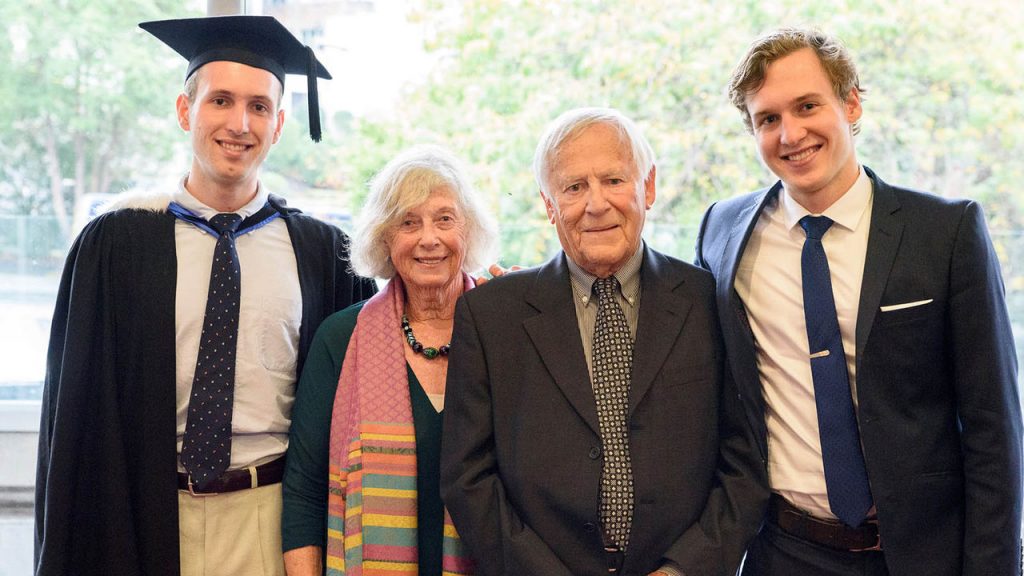
Keith Sorrenson pictured with his wife Judith and two of his grandsons, Peter (left) and David (right).
I was one of the many students privileged to be taught in the University’s history department by Emeritus Professor of History M.P.K. (Keith) Sorrenson, who died on 26 July, aged 93.
As a teacher, Keith instilled in me, as he did with many other students, a passion for history and a respect for knowledge, evidence and critical thinking. He later became my valued colleague from 1988.
Keith was born in 1932 and identified with both his Māori (Ngāti Pukenga) and Pākehā heritage, shaping his lifelong scholarly interests in race relations and cultural interactions in New Zealand.
He grew up on a farm in upper Papamoa, Tauranga, and completed his masters degree at the University of Auckland in 1955. His MA thesis on the purchase of Māori lands from 1865 to 1892 was later described by historian Dame Judith Binney as a “pioneering work without parallel”.
Keith was a junior lecturer in the University’s history department from 1957 to 1958, after which he undertook his doctorate on African history at Oxford, graduating in 1962. He then went to Makerere University in Uganda from 1963 to 1964, furthering his research interests in colonial and inter-racial history. On returning to New Zealand, he took up a lectureship at Auckland in 1964, speedily being appointed to a chair in 1968, which he held until he retired to become an historical consultant for the Waitangi Tribunal in 1995. During his career he always sought to connect with scholars internationally, particularly in the UK, North America and Africa.
In 1997, the New Zealand Journal of History, of which Keith had been associate editor and then co-editor, produced a festschrift for him. This included a tribute from Professor Alan Ward, who, like Keith, had been central to the reappraisal of New Zealand’s colonial history, beginning in the 1970s. Alan noted that the 1960s and 1970s were exciting decades in which New Zealand history went from strength to strength and that, in their exploration of Māori-settler interactions, Keith, along with others such as Judith Binney, made significant contributions, both as teachers and researchers.
Keith also performed a conscience-of-society role as an active member of the Citizens Association for Racial Equality (president 1971–1973); he petitioned then-prime minister Norman Kirk in 1972 against a proposed Springbok Tour and joined protests opposing the 1981 visit.
In 1986 he was appointed a member of the Waitangi Tribunal and was a panel member on 14 tribunal inquiries, contributing immensely to the writing of many tribunal reports.
Keith also instilled a passion for history in his son Richard, who undertook a PhD in the History of Science at Princeton University before returning to New Zealand and managing the University of Auckland Foundation and its endowment fund.
In Keith’s final book in 2014, Ko te Whenua te Utu/Land is the Price: Essays on Māori History, Land and Politics, which collected his formative essays in one place, he modestly pointed out that his is not the last word; that historians constantly ‘refashion’ history. He is right, but this does not belittle the enormous contribution he made to the historical endeavour.
Keith is survived by his wife Judith, their three children, three grandchildren and one great grandchild.
This obituary first appeared in the September 2025 issue of UniNews
Chris Jones, 1977-2024

In Memoriam: Associate Professor Chris Jones, 1977-2024
Chris Jones, who has died suddenly on a visit to his parents’ home in Surrey, England, at the age of 47, was an influential medieval historian who taught for 18 years at the University of Canterbury, Christchurch.
Chris’ first monograph Eclipse of Empire? Perceptions of Western Empire and its Rulers in Late Medieval Europe (2007) reevaluated the hitherto commonplace view that the waning of the Empire after the death of Frederick II of Hohenstaufen was paralleled by the rise of the French nation state led by Philip IV the Fair. Chris’ meticulous study of chronicles successfully challenged the mainstream interpretation and received a number of positive reviews.
Despite his eventual career choice, history did not dominate Chris’ intellectual love as a teenager. Apart from his enthusiasm for science fiction such as Doctor Who and Star Wars, the schoolboy at St Bede’s School in Redhill, Surrey, exceled in both mathematics and history. It was in the sixth form that he opted for history and subsequently enjoyed student life at Grey College in the University of Durham, where Len Scales, Robert Dyson and other distinguished medievalists sparked Chris’ interest in medieval political thought before his academic training took him further to Paris and Toronto.
A medieval thinker who has fascinated Chris since his undergraduate years was the late thirteenth-century Dominican John of Paris, who has typically been portrayed as an ideologue of the French monarchy in opposition to imperial universal rule. A large collection of essays, John of Paris: Beyond Royal and Papal Power (2015), which Chris edited single-handedly, offered the first comprehensive appraisal of the Dominican thinker. His last book, Rethinking Medieval and Renaissance Political Thought (2023), co-edited with me, constituted a manifesto for future research.
Although Chris’ academic pedigree may sound traditionally European (as indeed a former student recalls him saying in the seminar with dramatic flair, ‘I am western culture’), his mind was wide-open to the rest of the world. His global perspective owed much to his experience in his youth. His father’s career as an aircraft safety engineer took Chris and his family to live in the Middle East in the 1980s. Having a mother who was formerly a flight attendant, Chris developed his love of travel and became adaptable to foreign cultures. He became head boy after studying for no more than a year at the British School Al Khubairat in Abu Dhabi. Later on in his life, he was often on a university mission happily overseas as Dean (International) in the College of Arts at the University of Canterbury.
The last decade was witness to Chris’ rise as an academic leader. Most notably, he served as President of the Australian and New Zealand Association for Medieval and Early Modern Studies (ANZAMEMS) from 2015 to 2021. During his term, he ensured that many fellow historians in New Zealand were on board with the Association’s activities and he contributed to globalising the scope of medieval and early modern studies at conferences. He also served on the editorial advisory board for Bloomsbury and ARC-Humanities Press.
Chris was a popular History lecturer at the University of Canterbury, enjoying large enrolments in all his undergraduate courses. His lectures were highly entertaining with amusing anecdotes and visual aids, yet remained systematic, accessible and informative. He attracted many Honours and postgraduate students, some already pursuing their academic careers. A student gave him the epithet (with fondness) ‘Chris Jones, Man of Luxury’. Having commuted in a European two-seater and always dressed in a tasteful suit, his stylish presence was eye-catching on campus.
He was exceptionally active in public engagement in the local community, thus cultivating the general public’s interest in historical heritage. He curated exhibitions on medieval manuscripts and a seventeenth-century copy of the Wicked Bible in New Zealand, and most recently ‘Saints in Coffee Jars’. For those occasions and others like the recent coronation of King Charles III, Chris showed flair as a broadcaster on TV and the national radio. He also led the digital humanities project on the medieval manuscript of the Canterbury Roll in New Zealand and oversaw the project of the History of the University of Canterbury to celebrate its 150th anniversary. He was a whirlwind.
Chris was as generous to his students as to his friends. He never failed to be caring and supportive with an excellent sense of humour. When I shared with him my frustrations with student teaching evaluations revolving around English being my second language, he told me that his own student feedback noted that Chris ‘speaks English well for a foreigner’. Meanwhile, he was also intolerant of nonsense. He was politely assertive about what he had to say. As a senior colleague noted, he was ‘the very model of a gentleman’.
As a recent podcast interview reveals, Chris was a genuinely thoughtful historian. His teaching and research were predicated on his belief that the European Middle Ages was relevant because studying medieval European culture, which is now alien to the moderns, helps cultivate empathy towards the Other in such a bicultural society as New Zealand. His historical scholarship was anchored in his optimism for humanity.
Just a week before his death, Chris enjoyed meeting colleagues and publishers at the International Medieval Congress in Leeds for the first time since the pandemic. He was excited about his new book project excavating medieval political thought in material culture. Chris’ premature passing prevented his imaginative and humane mind from pioneering in the new field of research. No doubt, however, his students and friends will carry the torch.
Takashi Shogimen
Professor of History, University of Otago
Chris was an exceptional supporter of the Ngai Tahu Research Centre at the University of Canterbury. He recognised the importance of te Tiriti o Waitangi/the Treaty of Waitangi in undertaking the historical study of any part of the world (even and especially his own field of European Medieval history) while living in Aotearoa New Zealand.
Martin Fisher
Senior Lecturer, Ngai Tahu Research Centre (University of Canterbury)
Ben Schrader, 1964-2024
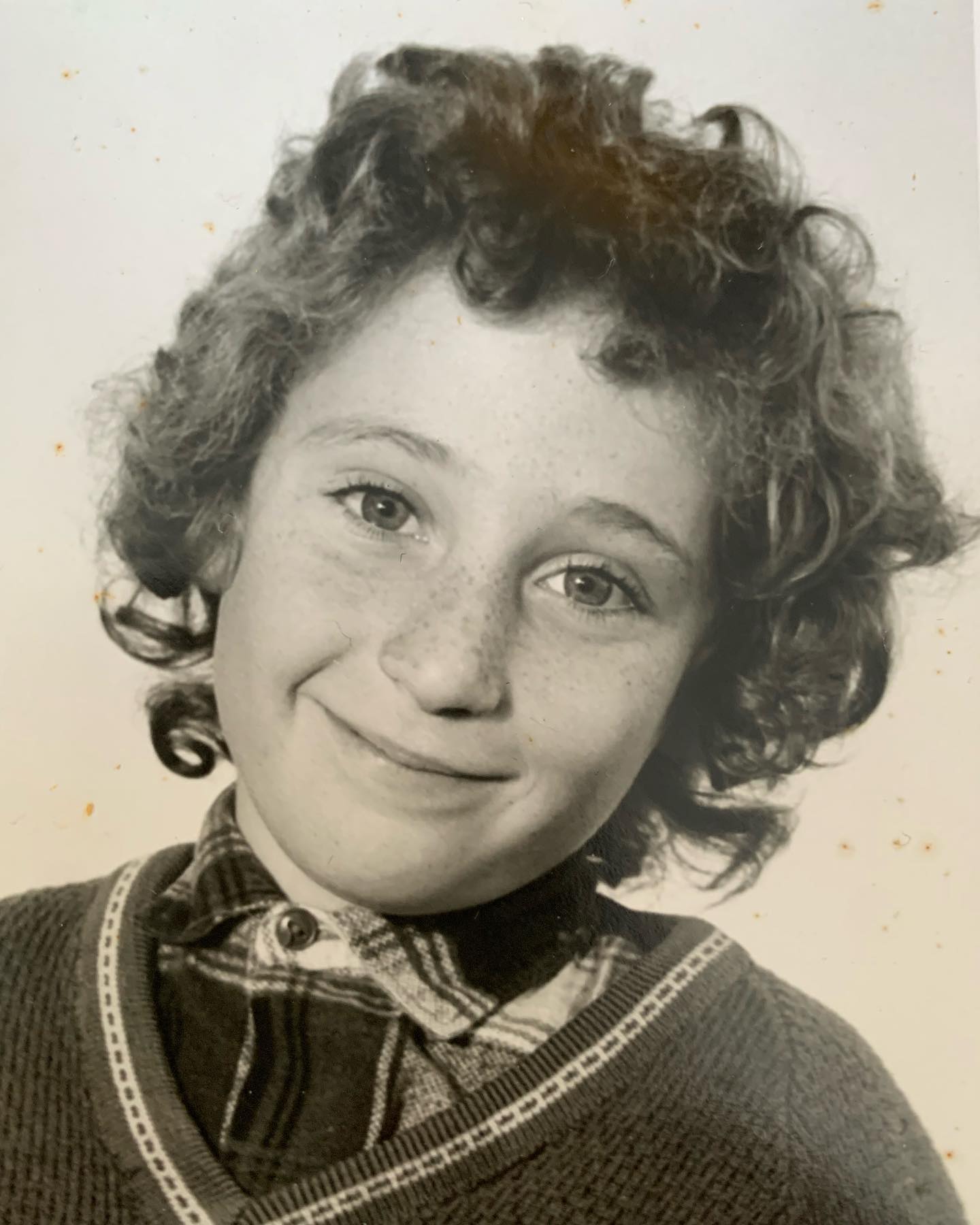
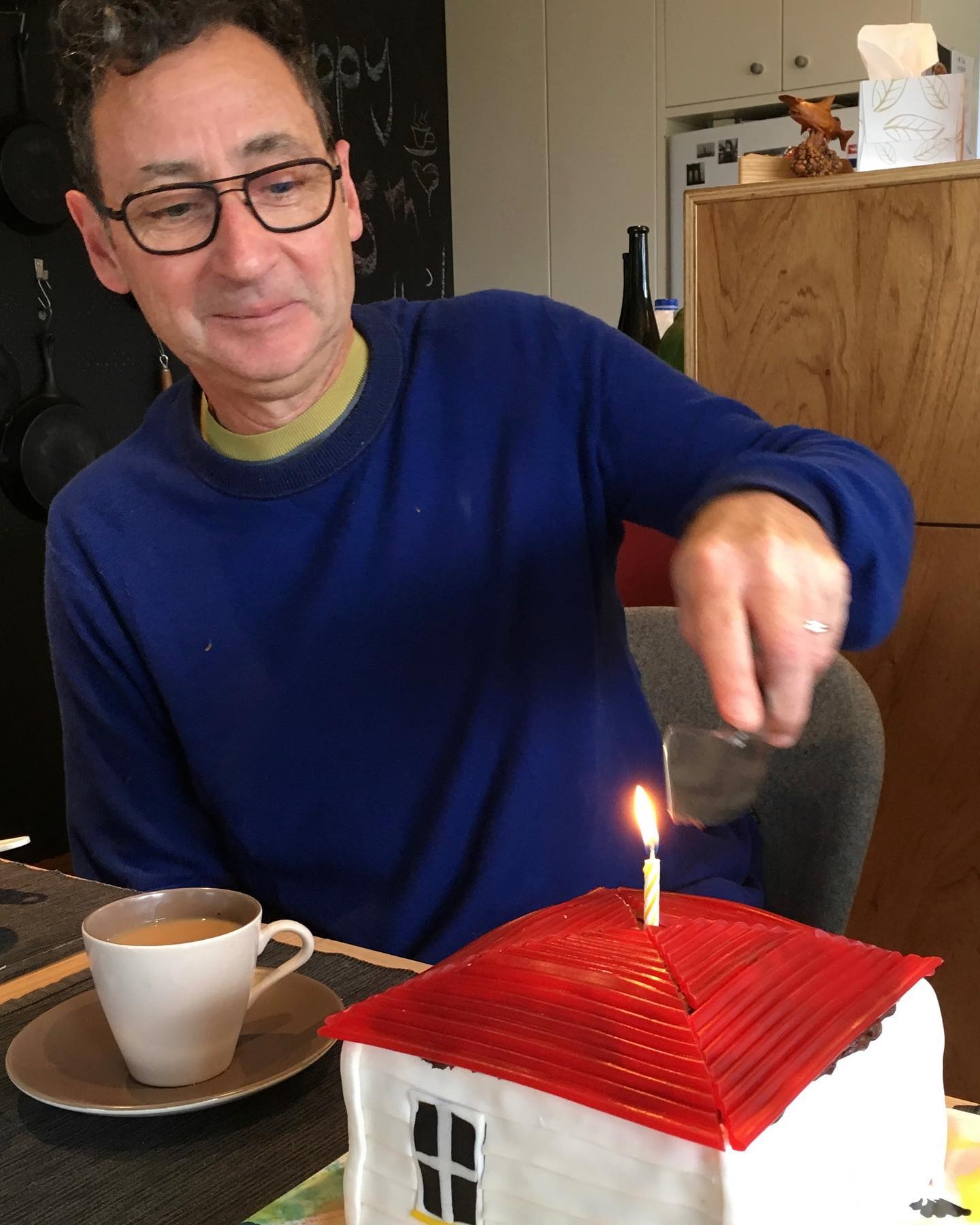
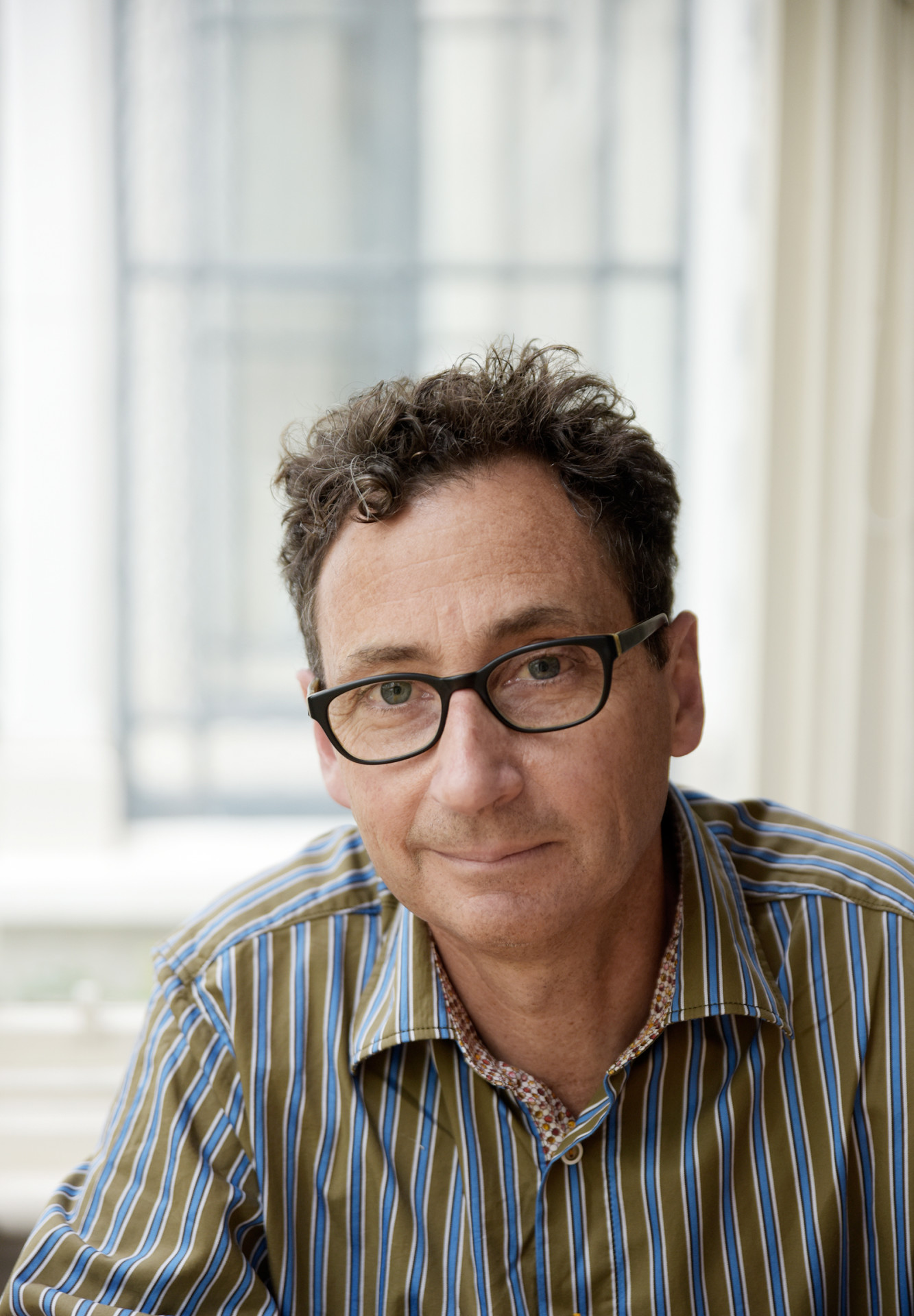
Ben was a historian of urban Aotearoa New Zealand, closely interested in the built environment of cities and towns, and the houses that people lived within. His 2016 book, The Big Smoke: New Zealand Cities 1840-1920 (BWB) has been highly influential in shifting how we understand the character of city and country in New Zealand’s modern history. The book won a number of awards including the NZHA W H Oliver Prize for the Best Book presented at the NZHA Conference in Auckland in November 2017.
Ben grew up in Christchurch and Wellington, as a twin in a large family. His father was a Presbyterian minister. After a BA at Victoria University of Wellington and an interest in architecture which took him to Auckland briefly, Ben returned to complete a BA (Hons) and MA degrees at Victoria University. His MA thesis, under David Hamer’s guidance, was on the state house community in 1940s Naenae (Hutt Valley): ‘Making Happy Families: The Naenae Idea’ (1993). The Naenae community centre was an idealistic vision which featured in filmreels in the 1950s and is about to reopen in the coming month.
After graduation, Ben worked on the New Zealand Historical Atlas where Malcolm McKinnon was general editor. Ben contributed a large number of plates to the final work, including one on the Naenae experiment.
He then moved to Australia completing a PhD with Graeme Davidson at the University of Melbourne. His PhD addressed the rebuilding of Melbourne’s central business district 1900-1940. He very generously returned temporarily to VUW when David Hamer died, in answer to a request from the interim heads of History, Susan Grogan/Foley and Pauline Keating. Ben taught David’s courses enabling students to complete their studies.
Returning to New Zealand permanently Ben taught into the Masters in Public History programme at VUW, then worked part time for Te Ara: the online encyclopedia of New Zealand. In these years Ben was also commissioned to write a major history of state housing. We Call it Home: a history of state housing (Reed) was published in 2005.
He was a founding member of PHANZA – the Professional Historians Association of New Zealand, in 1995 serving in a number of roles for the Association. Ben spent much of his career as an independent historian, interweaving that work with raising his two children alongside partner Lis Cowey.
Ben was an energetic and effective advocate for a wide range of urban and heritage causes, leaving a strong mark on the shape of Wellington and other parts of New Zealand. As his brother Paul noted, Ben ‘was a strong advocate for heritage and preservation but in a way that reflected a social concern about lives lived and those still engaging with their built environment.’ (Instagram, 21.2.24)
Ben held the J D Stout Fellowship in 2022, working on a book on heritage histories in Aotearoa. He has a piece in the forthcoming collection Urban Aotearoa: The Future of Our Cities, ed David Batchelor and Bill McKay (BWB, Text, 2024).
Ben was diagnosed with cancer 12 years ago, courageously and quietly dealing with the disease that at various times reached a critical moment.
Those of us who knew Ben knew a warm, welcoming, exceptionally kind person who was tremendously passionate about his subject and very generous to all about him. He will be greatly missed.
A memorial service for Ben was held in Shed 11 the old waterfront building now used as the New Zealand Portrait Gallery in Wellington on the evening of 24 April 2024. The large space was full to bursting with all those who knew, loved and respected Ben.
We extend our deepest sympathies to Lis, Fred and Carlo, and all of Ben’s family and friends.
Moe mai rā.
Charlotte Macdonald
Te Herenga Waka – Victoria University of Wellington
 The New Zealand Historical Association